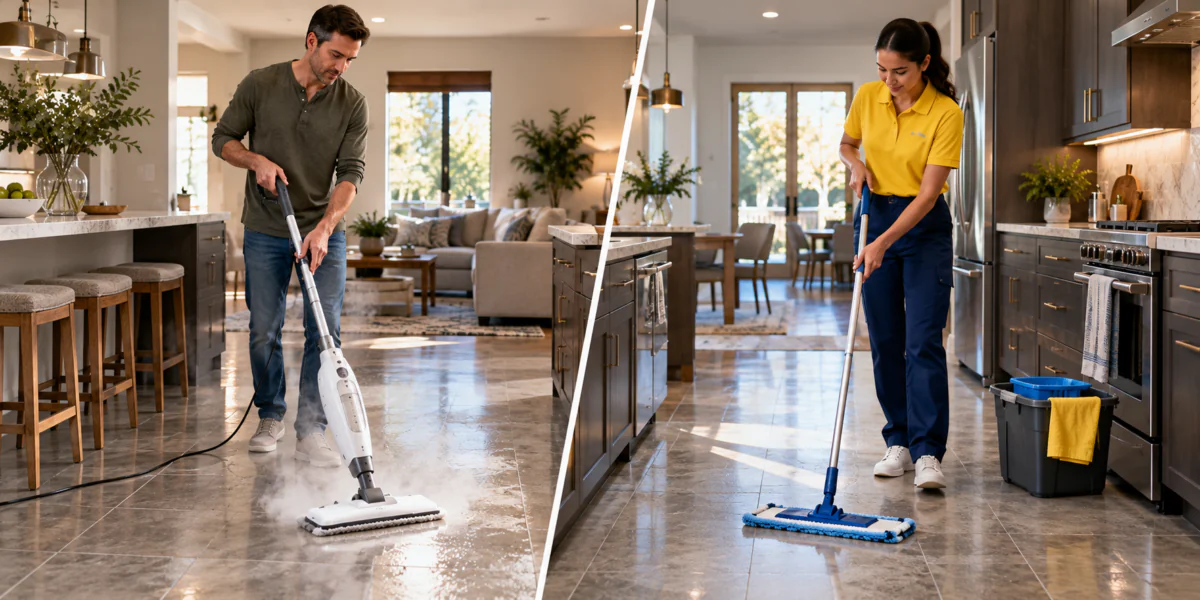
A mop is about as basic as cleaning equipment gets.
A handle.
A cleaning pad or mop head.
Some water.
Maybe a bucket.
Steam cleaners seem much more advanced.
They heat water, generate steam, and promise to loosen grime with less scrubbing and fewer conventional cleaning products.
So does that make a steam cleaner better than a traditional mop?
Sometimes.
But not nearly as universally as the marketing might suggest.
The better tool depends heavily on what you’re cleaning, how dirty it is, and what the floor is made from.
How a Regular Mop Cleans
Traditional mopping depends primarily on:
- Water
- Cleaning solution
- Mechanical agitation
- Absorption
A microfiber mop physically lifts dirt from the floor.
When used correctly, microfiber can capture a surprising amount of debris.
The biggest advantage is control.
You can determine:
- How wet the mop is
- Which cleaning solution you use
- How much pressure to apply
- How often you rinse
- Which areas need additional attention
That flexibility makes ordinary mopping compatible with many different flooring types.
How a Steam Mop Cleans
Steam mops heat water until it produces hot vapor.
The combination of:
- Heat
- Moisture
- Mop-pad agitation
can loosen certain grime.
This can be particularly useful on suitable sealed, heat-resistant surfaces.
But there’s an important misconception:
Steam doesn’t make dirt disappear.
The loosened dirt still needs to be physically collected by the mop pad.
If the pad becomes filthy and you continue moving it around the room, you’re not necessarily improving the result.
Where Steam Has an Advantage
Steam can help soften some stubborn residue.
That can reduce the amount of physical scrubbing required.
On compatible tile surfaces, for example, this may make floor cleaning faster and easier.
Steam may also appeal to homeowners who want to reduce the amount of conventional cleaning product they use.
But that advantage only matters when the surface can safely tolerate the heat and moisture.
Where a Regular Mop Has the Advantage
Traditional mopping wins on versatility.
You can change:
- Cleaning solution
- Water temperature
- Mop moisture
- Pressure
- Cleaning pad
That gives you far more control.
A regular microfiber mop also doesn’t expose flooring to the same high temperatures produced by steam equipment.
For sensitive surfaces, that matters.
Tired of Comparing Cleaning Tools?
You don’t need a closet full of cleaning gadgets to have a clean home.
Marching Maids can handle the bathrooms, kitchens, floors, dusting, and other routine cleaning for you.
Steam Mop vs. Mop on Tile
Tile is one of the areas where steam equipment can make the most sense.
Ceramic and porcelain tile can generally tolerate conditions that would be risky for wood.
Steam can loosen grime on suitable surfaces.
A conventional mop also performs well, particularly for routine maintenance.
The deciding factor may therefore be the type of dirt.
For ordinary dust and footprints, a microfiber mop may be faster.
For certain stubborn residues, steam may provide an advantage.
What About Grout?
Grout often gets included in the steam-cleaner conversation.
Steam may help loosen surface grime.
But heavily stained grout can require additional cleaning.
And not every dark grout line is simply dirty.
Some discoloration may be permanent.
Damaged or poorly sealed grout also deserves caution.
Steam Mop vs. Mop on Hardwood
This is where a conventional mop generally has a significant advantage.
Not because hardwood likes mops.
Because a microfiber mop can be used with very little moisture.
Steam introduces both high heat and moisture.
Some hardwood manufacturers specifically prohibit steam cleaning.
We’ve gone into this issue separately in our guide to [whether you can safely steam clean hardwood floors](/blog/steam-clean-hardwood-floors/).
With expensive flooring, always follow the manufacturer’s recommendations.
Steam Mop vs. Mop on Laminate
Laminate can also be sensitive to moisture entering seams.
Excessive moisture can swell the underlying material.
Traditional microfiber mopping gives you more control over how wet the floor becomes.
Unless the laminate manufacturer specifically approves steam, we’d favor the more conservative approach.
What About Vinyl?
Vinyl flooring varies considerably.
Some products are extremely water-resistant.
But heat, seams, and adhesives can complicate the question.
Again, waterproof doesn’t necessarily mean approved for steam.
Check the manufacturer’s instructions.
Which Is Faster?
For everyday floor maintenance, a traditional microfiber mop can actually be faster.
There’s no:
- Heating period
- Machine setup
- Electrical cord
- Tank
- Cool-down period
For more stubborn compatible surfaces, steam may save scrubbing time.
So there isn’t one winner.
It depends on the job.
Which Is Easier to Maintain?
A basic mop is difficult to beat.
Wash the pad.
Clean the bucket.
Done.
Steam cleaners involve:
- Water reservoirs
- Heating elements
- Attachments
- Pads
- Potential mineral buildup
- Electrical components
Hard water can also leave deposits inside some steam equipment.
That means the tool designed to make cleaning easier eventually needs cleaning itself.
Which Costs Less?
A microfiber mop is inexpensive.
A good steam cleaner costs considerably more.
Replacement pads and maintenance may add additional expense.
That doesn’t mean steam equipment isn’t worth owning.
It simply means the machine needs to solve a real cleaning problem to justify the cost.
If you already maintain your floors easily with a $25 microfiber mop, purchasing another appliance may not dramatically improve your life.
Which One Cleans Better?
This is the question people really care about.
And the answer is:
Neither automatically cleans better.
A professional cleaner with a basic microfiber mop can outperform someone using an expensive steam cleaner incorrectly.
Good technique matters.
That includes:
- Removing dry debris first
- Using clean mop pads
- Changing dirty water
- Selecting the right product
- Using appropriate moisture
- Paying attention to corners and edges
Equipment helps.
Technique matters more.
Vacuum Before Either One
No matter which wet-cleaning method you choose, remove dry debris first.
Otherwise dust, sand, hair, and crumbs become wet debris that you’re pushing around the floor.
Vacuuming first usually produces a much better result.
This is one reason robot vacuums can complement traditional cleaning so effectively.
They can maintain floors between deeper cleanings.
We’ve examined that in our guide to whether robot vacuums are really enough to keep a home clean.
Do You Need Either One Every Day?
Usually not.
Floor-maintenance frequency depends on:
- Pets
- Children
- Foot traffic
- Shoes indoors
- Flooring color
- Outdoor environment
- Cooking
- Household size
Vacuuming high-traffic areas frequently often matters more than wet-cleaning every day.
When I’d Choose a Steam Cleaner
Steam may make sense when:
- The surface manufacturer approves it
- You have appropriate tile or other compatible hard surfaces
- You’re dealing with residue that benefits from heat
- You specifically want to reduce certain conventional cleaning products
- You’re willing to maintain the machine
When I’d Choose a Traditional Mop
I’d choose microfiber when:
- The flooring is moisture-sensitive
- You want maximum control
- You’re performing ordinary maintenance cleaning
- You don’t want another appliance
- The floor manufacturer discourages steam
Do Professional Cleaners Need Steam Cleaners?
Not necessarily.
Professional cleaning isn’t defined by having the most elaborate equipment.
It’s about producing consistent results without damaging the customer’s home.
Sometimes that means specialized equipment.
Sometimes it means a microfiber cloth and the correct cleaning solution.
The best cleaner isn’t necessarily the person with the strongest machine.
It’s the person who knows which method to use.
Steam Is One Tool, Not the Entire Cleaning System
This is ultimately the biggest lesson.
Steam cleaners can be useful.
So can:
- Vacuums
- Microfiber
- Scrub brushes
- Mop systems
- Cleaning solutions
No one tool replaces all of the others.
That’s why we’ve also put together a broader guide explaining whether steam cleaners are actually worth it for everyday household cleaning.
The answer depends much more on your home than on the machine.
The Verdict
If your floors are compatible and you frequently deal with stubborn residue, a steam cleaner can be a useful addition.
For most ordinary floor maintenance, however, a quality microfiber mop remains hard to beat.
It’s inexpensive.
Simple.
Controllable.
And compatible with a much wider variety of flooring when used correctly.
The best approach isn’t:
Steam or mop?
It’s:
Which method is safest and most effective for this particular floor?
That’s the question worth answering before plugging anything in.
Skip the Mop Altogether
Marching Maids can handle floors, bathrooms, kitchens, dusting, and the rest of your routine household cleaning.
Fast online pricing • No obligation
Call (888) 571-9181
Keep Reading
Are Steam Cleaners Worth It for Everyday Cleaning?
What Should You Never Steam Clean?https://marchingmaids.com/blog/what-not-to-steam-clean/
Can You Steam Clean Hardwood Floors?https://marchingmaids.com/blog/steam-clean-hardwood-floors/