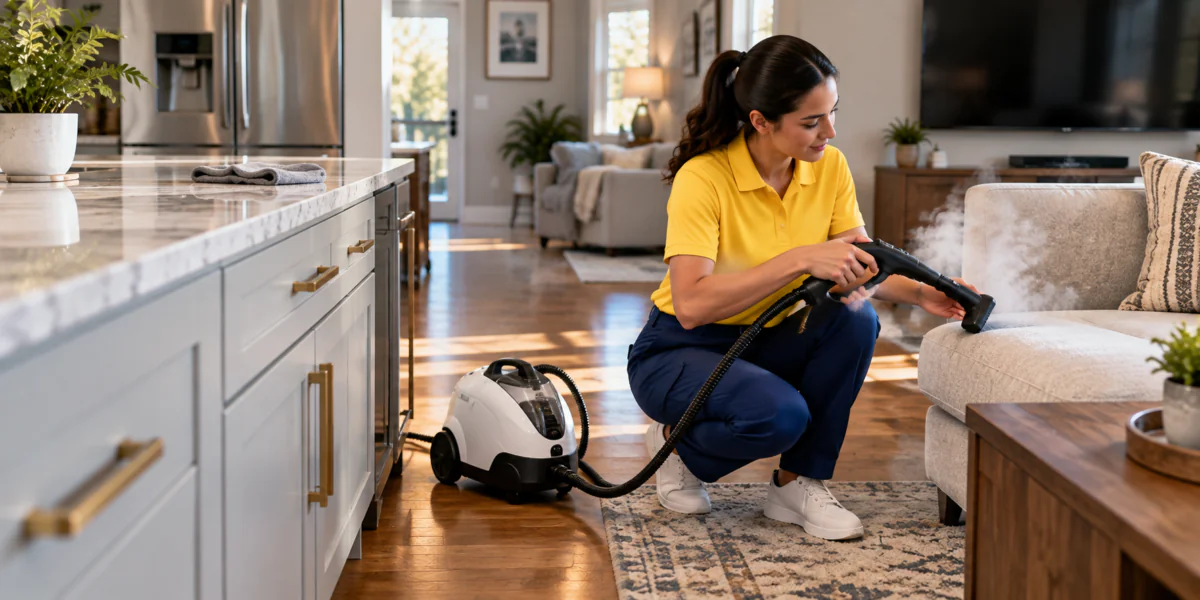
Steam cleaners are often marketed as one of the most versatile cleaning tools you can own.
Add water.
Let the machine heat up.
Point the nozzle at dirt.
And watch grime loosen without needing much conventional cleaning product.
That sounds simple.
But steam is still a combination of high temperature and moisture, and not every surface in your home handles those things well.
Used correctly, steam can be useful on certain sealed, heat-resistant surfaces.
Used incorrectly, it can discolor finishes, loosen adhesives, warp flooring, damage electronics, or permanently mark materials that would have been perfectly fine with ordinary cleaning.
So before moving through the house with a steam cleaner, it helps to know where not to use one.
Here are some of the most important surfaces to approach carefully—or avoid altogether.
1. Unsealed Hardwood Floors
Hardwood and moisture have never been particularly good friends.
Steam cleaners introduce both moisture and heat into the equation.
If hardwood flooring isn’t properly sealed, moisture can work its way between or underneath the boards.
Over time, that can contribute to:
- Swelling
- Warping
- Cupping
- Discoloration
- Finish damage
Even sealed hardwood deserves caution.
Manufacturers may specifically recommend against steam cleaning because repeated exposure can eventually affect the finish or force moisture into small gaps.
When dealing with expensive hardwood, manufacturer’s cleaning recommendations should always take priority over what a steam-cleaner advertisement promises.
2. Laminate Flooring
Laminate often looks durable, but its construction makes excessive moisture risky.
Many laminate floors contain a fiberboard core underneath the decorative surface.
If steam works its way into seams, that core can swell.
Once laminate swells or separates, cleaning isn’t going to fix it.
The flooring may need replacement.
A slightly damp microfiber mop is generally a much safer approach.
3. Luxury Vinyl Flooring With Questionable Seams
Vinyl itself can tolerate moisture well.
The concern is often underneath it.
Heat and moisture can potentially affect adhesive or penetrate damaged seams.
That doesn’t mean every vinyl floor is automatically unsafe for steam cleaning.
It means you should check the flooring manufacturer’s recommendations before assuming that waterproof flooring is also steam-proof.
Those aren’t necessarily the same thing.
4. Natural Stone
Stone sounds indestructible.
It isn’t.
Materials such as marble, limestone, and travertine can be surprisingly sensitive.
Natural stone may be protected by sealers that high heat can affect.
Certain surfaces are also vulnerable to staining, etching, or moisture intrusion.
Steam may seem attractive because it avoids acidic cleaners, but that doesn’t automatically make it safe.
For expensive stone surfaces, use products and methods specifically recommended for that particular stone.
Unsure What Products Are Safe Around Your Home?
Different surfaces require different cleaning methods.
Marching Maids can help with regular cleaning, deep cleaning, and detailed household cleaning without turning every surface into a chemistry experiment.
5. Painted Walls
A small amount of steam probably isn’t going to make every painted wall collapse.
But concentrated heat and moisture can soften certain paints or affect the bond between paint and the wall underneath.
Possible problems include:
- Bubbling
- Peeling
- Discoloration
- Streaking
This becomes especially risky with older paint, low-quality finishes, or areas where the paint is already damaged.
For ordinary wall marks, a microfiber cloth and appropriate cleaning solution are usually safer.
6. Painted Cabinets
Kitchen and bathroom cabinets experience the same problem.
Steam may soften finishes or work into joints and edges.
Cabinet doors also frequently contain engineered wood underneath the painted surface.
If moisture gets through damaged paint or seams, swelling may occur.
Steam can be useful around some kitchen areas, but spraying it directly onto painted cabinetry isn’t something we’d recommend without manufacturer approval.
7. Electronics
This one should be obvious, but handheld steamers can tempt people to clean everything.
Do not direct steam into:
- Televisions
- Computers
- Game consoles
- Speakers
- Electrical outlets
- Power strips
- Appliances with exposed controls
Steam is water.
Water and energized electronics don’t mix.
Even if an appliance is unplugged, moisture entering internal components can cause corrosion or damage later.
8. Certain Upholstery
Steam can be useful on some fabrics.
It can also damage others.
Potential problems include:
- Water marks
- Dye bleeding
- Shrinkage
- Fabric distortion
- Damage to adhesives beneath upholstery
Before cleaning upholstered furniture, check the care label.
Furniture cleaning codes often indicate whether water-based cleaning methods are appropriate.
And always test an inconspicuous area first.
9. Delicate Fabrics
Silk, certain velvets, specialty fabrics, and materials with unstable dyes deserve particular care.
A garment steamer is designed primarily to relax wrinkles.
That’s different from saturating a fabric in an attempt to remove dirt or stains.
When the fabric is expensive or delicate, professional cleaning may be safer than experimentation.
10. Wallpaper
Steam is actually used intentionally to remove wallpaper.
That tells you almost everything you need to know.
Heat and moisture can soften wallpaper adhesive.
If your goal is to keep the wallpaper on the wall, repeatedly directing steam at it isn’t ideal.
11. Waxed or Polished Surfaces
Heat can soften or remove wax.
That includes some:
- Furniture finishes
- Flooring treatments
- Specialty countertops
- Decorative surfaces
You may clean the dirt while accidentally removing the protective finish underneath.
That’s not a great trade.
12. Anything You Can’t Identify
This may be the most important rule.
Homes contain countless materials.
A countertop that looks like stone could be quartz, marble, granite, porcelain, or a manufactured material.
Flooring that looks like wood could be hardwood, engineered wood, laminate, or vinyl.
Fixtures may have specialty coatings.
When you don’t know what something is made from, don’t assume high-temperature steam is harmless.
Identify the material first.
Why Steam Cleaners Can Cause Damage
Steam cleaning works precisely because steam carries energy.
Heat can loosen grease and grime.
Moisture can soften residue.
Pressure can help dislodge dirt.
Those benefits also create the risks.
The same heat that loosens grease may affect adhesive.
The same moisture that loosens dirt may penetrate wood.
The same pressure that pushes grime out of grout may force moisture into a seam.
There is no cleaning tool that’s ideal for every surface.
Where Steam Cleaning Can Be Useful
None of this means steam cleaners are bad.
Used appropriately, they can be very useful.
Depending on the equipment and manufacturer recommendations, steam may work well for certain:
- Ceramic tile
- Porcelain tile
- Shower areas
- Grout
- Heat-resistant bathroom surfaces
- Some sealed countertops
- Certain appliance surfaces
We’ve taken a broader look at the pros and cons in our guide to whether steam cleaners are worth it for everyday cleaning.
The important point is that “steam cleaner” doesn’t mean “safe everywhere.”
Professional Cleaners Don’t Use One Method for Everything
One of the reasons professional cleaning requires experience is that homes contain so many different materials.
A cleaner may use one method on:
- Glass
Another on:
- Wood
Another on:
- Stainless steel
Another on:
- Stone
And something completely different on:
- Upholstery
The goal isn’t to find the strongest possible cleaning method.
It’s to find the least aggressive method that produces the desired result without damaging the surface.
That’s a good rule whether you’re using steam, chemicals, scrub brushes, or anything else.
Steam Isn’t Automatically Better Because It Uses Less Chemical Cleaner
“Chemical-free” is often used as a selling point for steam.
But water is still interacting with the material you’re cleaning.
And heat dramatically changes that interaction.
A cleaning method doesn’t become harmless simply because it comes out of a machine filled with water.
Surface compatibility matters more than marketing language.
A Simple Rule Before Steam Cleaning Anything
Before using steam on an unfamiliar surface, ask:
What material is this?
Then:
Does the manufacturer say steam is safe?
If you don’t know the answer, use a gentler cleaning method until you do.
Replacing flooring or cabinetry because of an unnecessary cleaning experiment can become extremely expensive.
The Bottom Line
Steam cleaning can be useful.
It can loosen grime.
It can reach small spaces.
It can reduce reliance on certain cleaning products.
But it’s not a universal solution.
Some of the most expensive surfaces in your home—wood floors, stone, cabinetry, furniture, and specialty finishes—are exactly where caution matters most.
Use steam where it makes sense.
Use another method where it doesn’t.
Good cleaning isn’t about using the most powerful tool.
It’s about using the right tool for the surface.
Rather Leave the Cleaning Decisions to Someone Else?
Marching Maids can help with regular house cleaning, deep cleaning, recurring cleaning, move-in cleaning, and move-out cleaning.
Get Pricing for Your Home
Fast online pricing • No obligation
Call: (888) 571-9181
Keep Reading
Are Steam Cleaners Worth It for Everyday Cleaning?