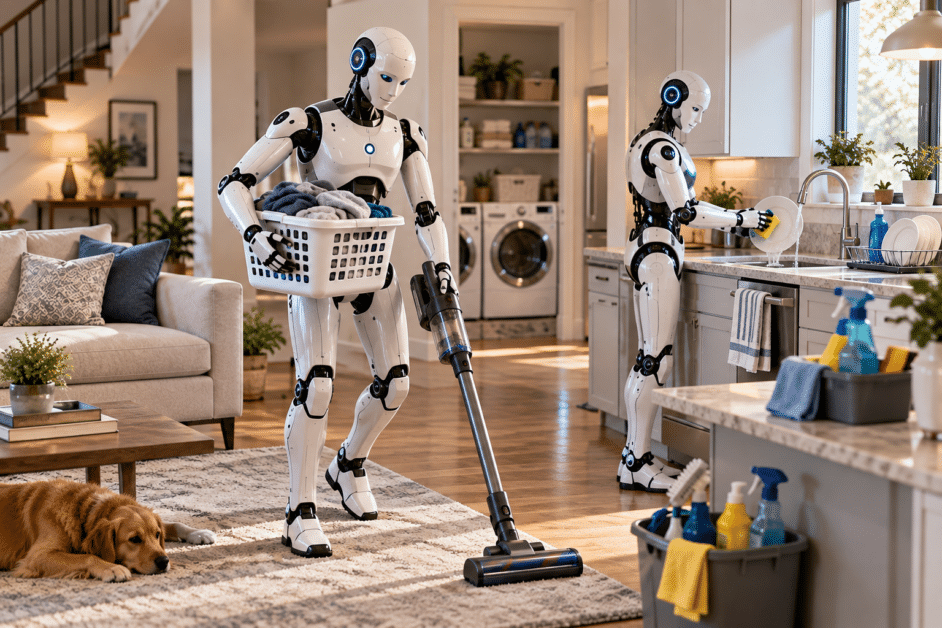
For generations, people have imagined a future where robots handle the housework.
Vacuum the floors.
Wash the dishes.
Fold the laundry.
Scrub the bathrooms.
Take out the trash.
Maybe even clean the entire house while you’re at work.
Until recently, most of that sounded like science fiction. But household automation is beginning to move beyond the robot vacuum.
Humanoid robots are now being developed specifically to operate inside homes, and some can already pick up objects, organize shelves, handle laundry, load dishes, and perform other basic household tasks.
That doesn’t mean a robotic housekeeper is about to replace every cleaning product in your closet.
Some chores are far easier to automate than others.
So which household tasks are likely to disappear from our to-do lists first?
Let’s work our way from the easiest jobs for robots to some of the hardest.
1. Vacuuming Floors
If there’s one household chore robots have already conquered, it’s vacuuming.
Robot vacuums work well because the task is predictable.
The robot has a clearly defined surface.
It can map the room.
It can detect obstacles.
It can follow a route.
And it doesn’t have to make many complicated decisions about what “clean” actually means.
Modern robot vacuums can do much more than simply bounce around the living room.
Depending on the model, they can:
Map individual rooms
Recognize carpet and hard flooring
Avoid furniture and obstacles
Increase suction on carpet
Return automatically to their charging station
Empty their own dust bins
Follow customized cleaning schedules
Avoid designated areas
Mop hard floors
For everyday dust, crumbs, pet hair, and debris, this is exactly the kind of repetitive job robots are good at.
But even the best robot vacuum has limitations.
Corners, stairs, furniture, baseboards, upholstery, and detailed cleaning still require additional work.
That’s why we consider robot vacuums more of a maintenance tool than a complete cleaning solution.
If you’re considering one, we’ve taken a deeper look at whether robot vacuums are really enough to keep your home clean.
Automation likelihood: Very high — already happening
2. Mopping Hard Floors
Floor mopping is following closely behind vacuuming.
Many newer robotic floor cleaners combine both functions.
The machine vacuums debris first and then passes a damp cleaning pad over hard flooring.
Some docking stations can even wash and dry the robot’s mop pads between cleaning cycles.
For routine maintenance, that’s impressive.
But there is an important difference between mopping a floor and cleaning a dirty floor.
A robot may be able to remove:
Light dust
Footprints
Small spills
Surface dirt
It may struggle much more with:
Dried food
Sticky residue
Heavy grease
Corners
Grout
Baseboard edges
Areas behind furniture
The harder the mess becomes, the more important pressure, inspection, and judgment become.
Automation likelihood: Very high
3. Picking Up Clutter
This is where humanoid robots become much more interesting.
Traditional cleaning robots operate primarily on floors.
Humanoid robots have arms and hands.
That potentially allows them to recognize objects, pick them up, and place them where they belong.
Imagine telling a robot:
Clean up the living room.
The robot might eventually be able to identify:
Shoes
Children’s toys
Clothing
Books
Cups
Pillows
Blankets
Remote controls
Then return each item to an appropriate location.
This could have a surprisingly large effect on household cleaning.
Professional cleaners frequently spend time working around items left on counters, floors, beds, and furniture.
If a household robot could handle basic organization before cleaning begins, maintaining the home could become much easier.
Automation likelihood: High
4. Taking Out the Trash
Taking out garbage is another relatively straightforward task.
A robot needs to:
Locate the trash container.
Remove the bag.
Carry it to another location.
Place it into a larger trash container.
Potentially replace the liner.
That requires more dexterity than vacuuming, but the overall objective is predictable.
Humanoid robots are particularly well suited to tasks like this because our homes are already designed around human-sized bodies.
Doors, trash cans, cabinets, hallways, and handles are positioned for people.
A human-shaped robot can potentially use those same spaces without requiring homeowners to redesign their homes.
Automation likelihood: High
5. Loading and Unloading the Dishwasher
Dishes are considerably more complicated.
At first glance, loading a dishwasher doesn’t seem difficult.
Humans do it without thinking.
But imagine the decisions involved.
Is the object a plate, glass, knife, bowl, or plastic container?
Is it fragile?
Where should it go?
Is there room for it?
Does it need to be rinsed first?
Is it dishwasher safe?
Does the glass belong in a cabinet afterward?
These decisions are simple for people because we’ve handled dishes thousands of times.
For a robot, they require vision, object recognition, hand control, and spatial reasoning.
The good news is that kitchen objects tend to be relatively predictable.
That’s why dishes are likely to become one of the first genuinely useful chores performed by general-purpose household robots.
Automation likelihood: High
Still Doing All of This Yourself?
Household robots are improving quickly, but most of us are still stuck with the bathrooms, kitchens, dusting, baseboards, and everything else.
Marching Maids can help with regular house cleaning, deep cleaning, move-in and move-out cleaning, and one-time cleaning.
Fast online pricing • No obligation
6. Moving Laundry
Laundry actually involves several completely different jobs.
A robot could potentially handle some much sooner than others.
For example:
Relatively easy:
Picking clothing off the floor
Moving a laundry basket
Carrying clothing to the laundry room
Loading clothes into a washing machine
More difficult:
Sorting whites and colors
Reading care labels
Deciding which clothing shouldn’t be machine washed
Measuring detergent
Identifying stains
Treating stains appropriately
And then we reach one of robotics’ surprisingly difficult challenges:
folding laundry.
7. Folding Laundry
Humans are incredibly good at manipulating soft objects.
We just don’t think about it.
Pick up a T-shirt and its shape constantly changes.
One sleeve folds underneath another.
The fabric twists.
The shirt collapses.
Unlike a coffee cup, it doesn’t have a fixed shape.
Robots have historically struggled with these kinds of objects.
Artificial intelligence and improved robotic hands are making significant progress, and several humanoid robots have demonstrated clothing-handling tasks.
But reliably folding an entire basket containing shirts, socks, towels, pants, underwear, and delicate clothing is much harder than a carefully controlled demonstration.
Laundry will therefore probably become partially automated before it becomes completely automated.
A robot may carry and sort the clothing long before it can handle every garment from hamper to closet.
Automation likelihood: Moderate to high
8. Wiping Kitchen Counters
Now things get interesting.
Moving a cloth across a countertop is easy.
Actually cleaning a kitchen counter properly isn’t.
The robot needs to recognize:
Crumbs
Grease
Dried food
Sticky residue
Spills
Appliances
Objects that shouldn’t get wet
It must then determine which cleaning product is safe for that particular countertop.
Granite, quartz, marble, butcher block, laminate, tile, and stainless steel don’t necessarily require the same care.
Then the robot needs to clean around:
Coffee makers
Toasters
Knife blocks
Containers
Small appliances
Decorative items
Electrical outlets
And afterward it needs to decide whether the surface is actually clean.
That’s considerably more complicated than following a floor map.
Automation likelihood: Moderate
9. Dusting
Dusting sounds easy until you look around your house.
Dust accumulates on:
Furniture
Shelves
Picture frames
Lamps
Window sills
Electronics
Ceiling fans
Blinds
Decorative objects
Baseboards
Door frames
Every object has a different shape.
Some objects can be moved.
Some can’t.
Some are fragile.
Some surfaces scratch easily.
Some electronics shouldn’t be sprayed.
And unlike vacuuming, there’s no single predictable plane for the robot to follow.
A robot may eventually handle open shelves and uncomplicated furniture very well while still struggling with detailed areas.
Automation likelihood: Moderate
10. Making the Bed
Making a bed is another deceptively difficult job.
A robot needs to manipulate large pieces of flexible fabric while navigating around an object much larger than itself.
It may need to:
Remove pillows
Straighten sheets
Pull fitted sheets
Position blankets
Smooth wrinkles
Replace pillows
Arrange decorative bedding
Simple bed-making could become common for household robots.
Changing fitted sheets is another matter entirely.
Anyone who has wrestled with a fitted sheet knows why.
Automation likelihood: Moderate
11. Cleaning Mirrors and Windows
Robots can already clean some windows using specialized devices.
But a general-purpose household robot would need to accomplish something different.
It must identify fingerprints, streaks, dust, and residue.
Then it needs to apply cleaning solution appropriately and polish the surface without leaving streaks.
Interior mirrors are probably easier.
Exterior windows introduce additional problems involving height, screens, tracks, safety, and access.
This is another area where specialized robots may outperform humanoid robots for certain applications.
Automation likelihood: Moderate
12. Cleaning the Shower
Now we’ve reached one of the jobs where human cleaners have a significant advantage.
A shower may contain:
Soap scum
Hard-water deposits
Mildew
Hair
Grout discoloration
Mineral buildup
Shampoo residue
Glass doors
Chrome fixtures
Natural stone
Tile
Acrylic or fiberglass
There isn’t one movement or one product that handles all of those surfaces.
A cleaner needs to inspect the shower first.
Then determine:
What is dirty?
What caused it?
What material am I cleaning?
Which product should I use?
How much pressure should I apply?
Did it actually come clean?
Those questions are much harder for a robot than following a mapped floor.
Automation likelihood: Low to moderate
13. Cleaning a Toilet
Physically, a humanoid robot could probably perform many of the movements required to clean a toilet.
The bigger difficulty is performing the entire task thoroughly and hygienically.
Cleaning a toilet involves different areas:
Bowl
Rim
Seat
Hinges
Tank
Exterior
Base
Floor surrounding the toilet
A cleaning robot would also need to manage its tools carefully to prevent cross-contamination.
The robot must understand that a cloth used on one part of the bathroom shouldn’t necessarily be used somewhere else.
Humans understand that immediately.
Robots need procedures and recognition systems to accomplish it reliably.
Automation likelihood: Low to moderate
14. Deep Cleaning a Kitchen
A kitchen deep cleaning combines almost every challenge we’ve discussed.
Grease.
Food.
Different materials.
Fragile objects.
Appliances.
Water.
Cleaning chemicals.
Electrical equipment.
Hard-to-reach areas.
Imagine instructing a robot:
Deep clean my kitchen.
That seemingly simple command could involve:
Degreasing the stovetop
Cleaning cabinet fronts
Wiping appliances
Cleaning inside the microwave
Scrubbing the sink
Removing buildup around the faucet
Cleaning backsplash grout
Moving countertop appliances
Wiping baseboards
Vacuuming
Mopping
This isn’t one task.
It’s dozens of separate tasks requiring different tools, products, movements, and decisions.
Automation likelihood: Low
15. Deep Cleaning an Entire House
This is the ultimate challenge.
A robot that can truly deep clean an entire house isn’t simply a better robot vacuum.
It’s a machine capable of understanding thousands of objects, materials, surfaces, stains, and situations.
It must know when to scrub harder.
And when not to.
It must recognize delicate surfaces.
It must understand cleaning chemicals.
It must detect dirt.
It must move objects without damaging them.
And perhaps most importantly, it must inspect its own work.
That last part may be one of the hardest problems of all.
Moving a sponge across a shower door isn’t particularly impressive if the soap scum is still there afterward.
A professional cleaner makes constant visual judgments:
That’s clean.
That needs another pass.
That product isn’t working.
I missed something behind the faucet.
Those tiny decisions happen hundreds of times during a cleaning.
That’s why the gap between a robot that can perform cleaning movements and a robot that can professionally clean a house remains significant.
Automation likelihood: Low—for now
Where Does Tesla Optimus Fit In?
Tesla Optimus receives enormous attention because Tesla is attempting to develop a general-purpose humanoid robot rather than a machine designed specifically for one household chore.
That distinction matters.
A successful general-purpose humanoid could potentially use many of the same cleaning tools humans already use.
Instead of purchasing one machine for vacuuming, another for windows, and another for mopping, you could theoretically have one robot capable of using normal household equipment.
That’s an extraordinarily ambitious goal.
We’ve looked more closely at this question in our article about whether Tesla Optimus could eventually replace traditional cleaning companies.
The answer isn’t simply about whether a robot can hold a vacuum.
The bigger question is whether it can make the hundreds of decisions a professional cleaner makes throughout an appointment.
Specialized Robots May Win Before Humanoid Robots Do
There’s another possibility.
The future of cleaning might not be one humanoid robot doing everything.
It could be several specialized machines.
We already see this happening.
Robot vacuums clean floors.
Automatic litter boxes handle pet waste.
Dishwashers clean dishes.
Washing machines clean clothing.
Robotic pool cleaners clean pools.
Window-cleaning robots can clean certain glass surfaces.
Each machine is extremely good at one narrow task.
That approach may prove more economical than building a $20,000 humanoid to do everything.
The downside?
Your house starts filling up with robots.
That’s why the idea of one general-purpose robot remains so appealing.
What About Steam Cleaning?
Some cleaning technologies may also become tools that future robots use rather than competitors to robots.
Steam is a good example.
Steam cleaners can loosen grime on certain surfaces without relying heavily on conventional cleaning chemicals.
But steam isn’t safe or effective for every material.
That means a future cleaning robot would need to understand not only how to use a steam cleaner, but when it shouldn’t use one.
We’ve covered the advantages and limitations in our guide to whether steam cleaners are worth it for everyday household cleaning.
That illustrates the larger challenge facing robotic cleaning:
The tool is often the easy part.
Knowing when and how to use it is harder.
The Household Chores Most Likely to Disappear First
If we were ranking common chores by how quickly they’re likely to become automated, the list would look approximately like this:
| Household Chore | Automation Potential |
|---|---|
| Vacuuming | Very High |
| Basic mopping | Very High |
| Picking up objects | High |
| Taking out trash | High |
| Loading dishwasher | High |
| Moving laundry | High |
| Folding laundry | Moderate–High |
| Making beds | Moderate |
| Wiping countertops | Moderate |
| Basic dusting | Moderate |
| Cleaning mirrors | Moderate |
| Cleaning showers | Low–Moderate |
| Cleaning toilets | Low–Moderate |
| Deep cleaning kitchens | Low |
| Whole-house deep cleaning | Low |
The pattern is fairly clear.
Predictable, repetitive jobs get automated first.
Tasks requiring judgment, inspection, different cleaning products, unusual movements, or constantly changing environments take longer.
Will Robots Eventually Do All of It?
Probably.
The question is less about what’s physically possible and more about when it becomes reliable and affordable enough for ordinary households.
We’re already seeing the first generation of humanoid robots designed specifically for homes.
1X, for example, is offering its NEO home robot with the ability to schedule household chores and learn additional tasks.
That’s a major step.
But early household robots don’t need to deep clean an entire four-bedroom house to be useful.
Imagine a robot that simply:
Picks up the living room
Loads the dishwasher
Carries laundry
Takes out the trash
Straightens the bedrooms
That alone could save a household several hours each week.
Then a robot vacuum handles the floors.
And a professional cleaner handles the detailed cleaning every week, two weeks, or month.
That may be the way home robotics actually arrives—not by replacing human cleaners overnight, but by gradually eliminating individual chores one at a time.
The Future of Cleaning Probably Isn’t Human vs. Robot
It’s tempting to frame household robotics as a competition.
Robots vs. cleaners.
But homes already combine people and automation.
Your dishwasher doesn’t prevent you from washing a pan by hand.
Your washing machine doesn’t fold your clothes.
Your robot vacuum doesn’t clean your shower.
Every piece of automation removes one piece of work.
Humanoid robots will probably extend that process.
They’ll pick things up.
Carry things.
Organize things.
Wipe things.
Eventually they’ll become capable of much more.
But professional cleaning may remain valuable precisely because humans are good at the messy, unpredictable, detailed work robots find hardest.
The future may look less like:
Robot OR cleaner
and more like:
Robot + cleaner + smarter household appliances.
And for homeowners, that’s probably the best outcome.
More automation.
Less housework.
And a cleaner home.
Until Your Robot Can Scrub the Shower, We Can.
Robots are already getting better at vacuuming, organizing, dishes, and laundry.
Bathrooms, kitchens, buildup, baseboards, detailed dusting, and whole-house cleaning?
Those are still much easier to leave to a professional.
Marching Maids can help with:
Regular house cleaning
Recurring cleaning
Deep cleaning
Move-in cleaning
Move-out cleaning
One-time cleaning
Get Pricing for Your Home
Fast online pricing • No obligation
Prefer to speak with someone?
Call Marching Maids at (888) 571-9181
Keep Reading About the Future of Cleaning
Will Tesla Optimus Replace Traditional Cleaning Companies?
Could Tesla’s humanoid robot eventually clean an entire house?
Read our Tesla Optimus analysis →
Are Robot Vacuums Really Enough to Keep Your Home Clean?
Robot vacuums have already automated one major household chore—but they have important limitations.
See where robot vacuums work and where they don’t →
Are Steam Cleaners Worth It for Everyday Cleaning?
Robots aren’t the only cleaning technology changing how homeowners maintain their homes.