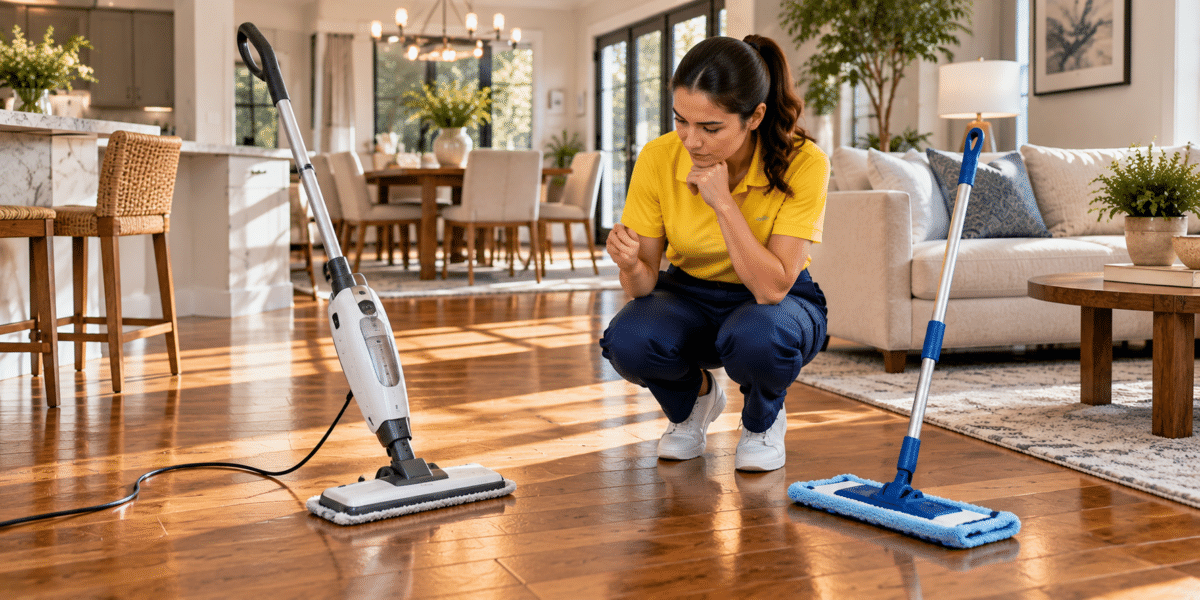
Steam mops make floor cleaning look incredibly easy.
Fill the reservoir.
Wait for the water to heat.
Move the mop across the floor.
And watch dirt disappear.
So if you have hardwood floors, it seems logical to use one there too.
Unfortunately, hardwood introduces a problem that tile doesn’t:
Wood reacts to moisture.
And steam cleaning combines moisture with heat.
That doesn’t mean every brief encounter between steam and wood instantly destroys a floor. But it does mean homeowners should be much more careful than many steam-cleaner advertisements suggest.
Why Steam and Hardwood Can Be a Bad Combination
Wood naturally absorbs and releases moisture depending on its environment.
That’s why hardwood flooring can expand and contract throughout the year.
A steam cleaner produces hot water vapor.
That vapor can potentially work into:
- Seams between boards
- Scratches
- Worn finish
- Edges
- Damaged areas
Once moisture gets underneath the protective surface, problems can begin.
Potential damage includes:
- Cupping
- Warping
- Swelling
- Finish discoloration
- Separation between boards
The concern becomes greater as floors age and their protective finishes wear.
But What If My Hardwood Is Sealed?
This is where advice often becomes confusing.
Some people assume:
sealed wood = safe for steam
That’s too simplistic.
A floor can appear sealed while still having tiny gaps, scratches, worn areas, or compromised edges.
Steam can also be pushed into seams under pressure.
And certain flooring manufacturers specifically advise against using steam cleaners even on finished hardwood.
The safest approach is therefore not to guess.
Check the recommendations from the flooring manufacturer.
If they prohibit steam cleaning, that’s the answer.
Engineered Hardwood Isn’t Automatically Safe Either
Engineered hardwood differs from solid wood.
It usually contains a real wood veneer over multiple supporting layers.
That construction can make engineered flooring more dimensionally stable.
But it doesn’t automatically make it safe for steam.
Heat and moisture may still:
- Affect the finish
- Enter seams
- Interact with adhesives
- Damage underlying layers
Again, manufacturer instructions matter.
What About Steam Mops That Say They’re Safe for Hardwood?
Some steam-mop manufacturers advertise certain products for sealed hardwood.
That’s one side of the equation.
The other side is the floor manufacturer.
If the mop company says:
Safe for sealed hardwood
but your flooring manufacturer says:
Do not steam clean
I’d follow the flooring manufacturer’s recommendation.
A steam mop costs far less to replace than a hardwood floor.
Want Clean Floors Without Guessing Which Method to Use?
Marching Maids can help with routine household cleaning and deep cleaning while using cleaning methods appropriate for the surfaces in your home.
What’s a Safer Way to Clean Hardwood?
For routine cleaning, hardwood generally doesn’t require huge amounts of water.
A common approach is:
- Vacuum or sweep loose debris.
- Use a well-wrung microfiber mop.
- Use an appropriate hardwood-floor cleaner when needed.
- Avoid allowing standing moisture to remain.
- Clean spills promptly.
The idea is simple:
Use enough moisture to clean the surface without saturating the wood.
Why Microfiber Works So Well
Microfiber is useful because it can collect dust and dirt without requiring a soaking-wet mop.
A slightly damp microfiber pad is often enough for routine maintenance.
This is very different from traditional string mops that can leave significant amounts of water behind.
For hardwood, less moisture is usually better.
Don’t Forget the Vacuum First
One of the easiest ways to improve floor cleaning is to remove dry debris before introducing moisture.
Dust, sand, and grit can behave like tiny abrasives underneath a mop.
Vacuuming first removes much of that material.
Robot vacuums can actually be particularly useful here because regular automated vacuuming prevents grit from accumulating.
We’ve examined their strengths and limitations in our article about whether robot vacuums are really enough to keep a home clean.
What About Really Dirty Hardwood?
This is where homeowners sometimes reach for increasingly aggressive methods.
More water.
More chemical cleaner.
More scrubbing.
Steam.
That can make matters worse.
If ordinary cleaning isn’t restoring the floor, the problem may not actually be dirt.
The finish itself could be:
- Scratched
- Worn
- Cloudy
- Damaged
- Discolored
Cleaning cannot repair a damaged finish.
Sometimes what looks like a cleaning problem is actually a flooring-maintenance problem.
Don’t Use Vinegar Automatically
Vinegar is another popular DIY cleaning recommendation.
But acidic cleaners may not be appropriate for every hardwood finish.
Repeated use can potentially affect certain finishes.
Just because something is natural doesn’t mean it’s appropriate for every surface.
That same principle applies to steam.
What If You’ve Already Steam Cleaned the Floor?
Don’t panic.
Using a steam mop once doesn’t necessarily mean you’ve ruined your flooring.
Look for changes such as:
- Raised board edges
- Cloudy finish
- Separation
- Swelling
- New discoloration
If everything looks normal, discontinue the method until you’ve confirmed whether your flooring manufacturer allows it.
Persistent damage may require evaluation by a flooring professional rather than additional cleaning.
Hardwood Is a Good Example of Why Cleaning Requires Surface Knowledge
A ceramic tile floor and hardwood floor may both be dirty.
But the safest method for one may be completely inappropriate for the other.
That’s why we don’t recommend treating every floor in a home the same way.
The same goes for countertops, furniture, fixtures, and bathroom surfaces.
Our broader guide to [what you should never steam clean](/blog/what-not-to-steam-clean/) covers several other materials where steam deserves caution.
Is Steam Ever Necessary for Hardwood?
For routine residential cleaning?
Usually not.
Vacuuming plus controlled damp cleaning can maintain hardwood extremely well.
Introducing extreme heat and additional moisture rarely provides enough benefit to justify unnecessary risk—particularly when the flooring manufacturer doesn’t approve it.
The Bottom Line
Can you steam clean hardwood floors?
Sometimes a manufacturer may approve a specific method on a specific sealed floor.
But you shouldn’t assume all hardwood is safe for steam.
Before using one, check both:
Your steam cleaner’s instructions
and
your flooring manufacturer’s cleaning instructions.
When there is any doubt, choose the gentler method.
The goal isn’t just to make your hardwood clean today.
It’s to keep it looking good for years.
Want the House Clean Without Experimenting on Your Floors?
Marching Maids provides regular, recurring, deep, move-in, and move-out cleaning.
(888) 571-9181
Keep Reading
Are Steam Cleaners Worth It for Everyday Cleaning?
What Should You Never Steam Clean? 12 Surfaces to Avoid
Link this to Article #4 once published:
https://marchingmaids.com/blog/what-not-to-steam-clean/