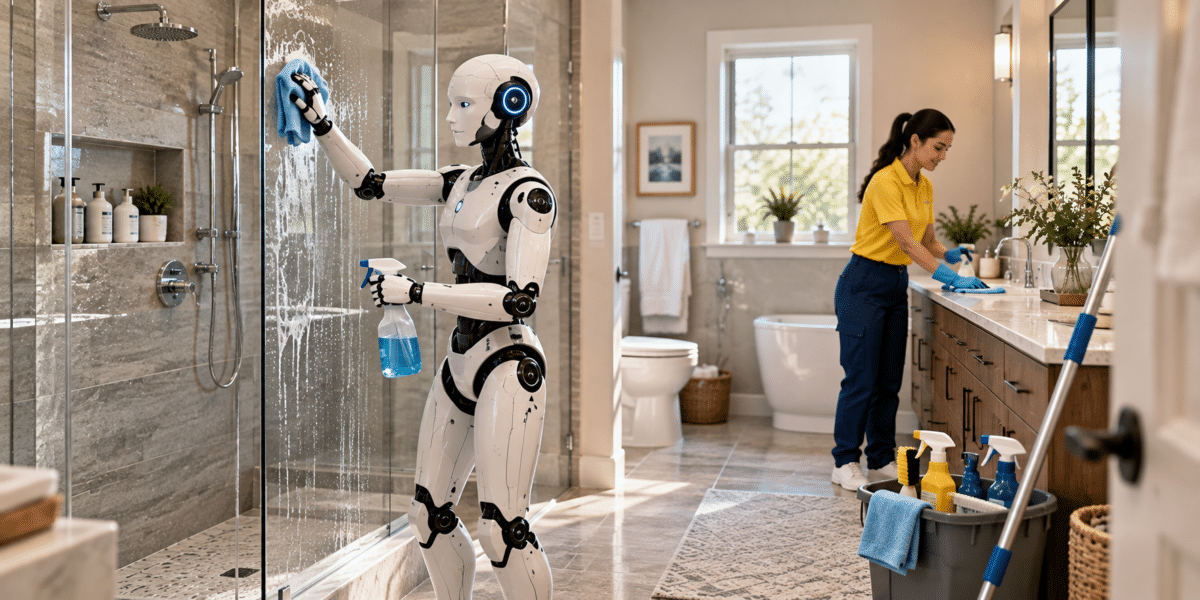
Robots can already vacuum floors, mop hard surfaces, carry objects, and perform basic household chores.
But deep cleaning a bathroom is different.
A bathroom combines almost everything that makes household cleaning difficult for robots:
Water.
Glass.
Tile.
Grout.
Hard-water deposits.
Soap scum.
Hair.
Cleaning chemicals.
Tight spaces.
Different surfaces.
And plenty of areas where simply wiping once isn’t enough.
So while a robot vacuum can follow a predictable route across a floor, a robot attempting to deep clean a bathroom has to make dozens of decisions.
That raises an interesting question:
Could a robot eventually deep clean a bathroom as well as a professional cleaner?
Probably.
But the task is considerably harder than it appears.
Cleaning a Bathroom Is Really Dozens of Separate Jobs
When someone says, “clean the bathroom,” it sounds like one task.
It isn’t.
A thorough bathroom cleaning can involve:
- Cleaning the toilet
- Scrubbing the shower
- Removing soap scum
- Cleaning shower glass
- Wiping mirrors
- Cleaning sinks
- Scrubbing faucets
- Removing mineral buildup
- Cleaning grout
- Wiping counters
- Dusting fixtures
- Vacuuming hair
- Mopping floors
- Cleaning baseboards
- Wiping cabinet fronts
- Moving toiletries
- Replacing items afterward
A human cleaner moves between these tasks almost automatically.
A robot would need to recognize each surface, identify what kind of dirt is present, determine which cleaning tool or product to use, and then inspect its own work.
That’s where things become complicated.
The First Problem: Recognizing What’s Actually Dirty
Humans are very good at spotting irregularities.
You can walk into a bathroom and immediately notice:
- Water spots on a mirror
- Soap scum on shower glass
- Hair around the sink
- Mildew in a corner
- Dust on the baseboard
- Hard-water buildup around a faucet
- Dirt around the base of the toilet
Nobody has to map those areas ahead of time.
You simply see them.
A robot has to accomplish the same thing using cameras, sensors, and artificial intelligence.
And simply detecting an object isn’t enough.
The robot needs to distinguish between:
Something that belongs there
and
something that needs to be cleaned.
A shampoo bottle on the shower ledge should stay.
Soap residue next to it should disappear.
A folded towel should stay.
Hair on the floor should not.
That kind of visual judgment is one of the biggest challenges facing autonomous household robots.
Soap Scum Is Harder Than It Looks
Soap scum is a perfect example of why bathroom cleaning is difficult to automate.
It isn’t always obvious.
Sometimes it’s a cloudy film.
Sometimes it’s concentrated around the bottom of a shower door.
Sometimes it combines with hard-water deposits.
And simply running a damp cloth over it may accomplish almost nothing.
A human cleaner might:
- Inspect the buildup.
- Choose an appropriate cleaner.
- Let the product sit.
- Scrub the surface.
- Rinse it.
- Inspect the glass.
- Repeat the process if necessary.
A robot would need to understand that the first pass didn’t work.
That’s much more complicated than following a programmed motion.
Hard Water Creates an Even Bigger Challenge
Homes in many parts of the country deal with mineral-heavy water.
Over time, calcium and other minerals can accumulate on:
- Faucets
- Showerheads
- Glass doors
- Tile
- Sinks
- Fixtures
This buildup may require a different cleaning approach than ordinary dirt.
A robot would need to identify the type of buildup and select an appropriate cleaning method without damaging the surface underneath.
That’s important because bathroom fixtures can include:
- Chrome
- Brushed nickel
- Brass
- Matte finishes
- Glass
- Natural stone
- Ceramic tile
- Porcelain
- Acrylic
- Fiberglass
The wrong cleaner can damage some of these materials.
So an effective bathroom robot needs more than physical strength.
It needs knowledge.
Choosing the Correct Cleaning Product Is Complicated
Cleaning chemicals introduce another major problem.
Humans learn that not every product can be used everywhere.
For example, certain cleaners may be inappropriate for:
- Marble
- Natural stone
- Specialty finishes
- Wood vanities
- Certain shower surfaces
A robot therefore can’t simply carry around one bottle and spray everything.
It needs to recognize the material first.
Then it needs to know which cleaning method is safe.
Then it needs to control how much product it applies.
Then it needs to make sure incompatible chemicals aren’t accidentally mixed.
That adds another level of decision-making.
Could Steam Make Bathroom Robots More Effective?
Possibly.
Steam cleaning could become a useful tool for future cleaning robots because it can loosen certain types of grime while reducing dependence on traditional cleaning chemicals.
But steam isn’t universally safe.
Some materials can be damaged by excessive heat or moisture.
So even a robot equipped with a steam cleaner would still need to make decisions about where it should—and shouldn’t—use it.
We’ve previously looked at whether steam cleaners are actually worth it for everyday household cleaning.
The same principle applies to robots.
The tool itself isn’t necessarily the difficult part.
Knowing when to use it is.
Cleaning Shower Glass Requires Inspection
Shower glass may look simple.
It’s a flat surface.
But anyone who has cleaned a heavily used shower knows that it can be stubborn.
You may have:
- Soap residue
- Hard-water spots
- Fingerprints
- Mineral deposits
- Shampoo splatter
- Streaking
A robot could easily move a cleaning pad across the glass.
The more difficult question is:
Did it actually come clean?
A good cleaner looks at the glass from different angles and notices haze or streaks.
If the first pass isn’t enough, they try again.
A cleaning robot therefore needs some ability to inspect the result.
Without that, it may technically perform the cleaning motion while leaving the bathroom looking almost the same.
Grout May Be One of the Hardest Jobs
Grout creates another challenge.
Grout lines are narrow.
They can darken over time.
And the robot needs to distinguish between:
- Normal grout color
- Surface dirt
- Mold or mildew
- Permanent staining
- Damage
A human can adapt pressure depending on the condition of the grout.
A robot would need to do the same without damaging surrounding tile.
This requires precise pressure control and reliable visual inspection.
Toilets Create a Hygiene Problem
A humanoid robot could probably learn the movements required to clean a toilet.
The bigger challenge is cross-contamination.
A professional cleaner understands that a cloth used around the toilet shouldn’t then be used on the bathroom counter.
That’s obvious to us.
For an autonomous robot, hygiene needs to become part of the operating system.
It needs to know:
- Which tools were used where
- When a cloth should be replaced
- When gloves or attachments should be cleaned
- Which surfaces require separate equipment
A robot that spreads bacteria from one surface to another isn’t really cleaning.
Hair Is Surprisingly Difficult
Hair is one of those bathroom problems that sounds trivial until you try to automate it.
Hair gets caught:
- Around drains
- Behind toilets
- Along baseboards
- Under cabinets
- On rugs
- Around sinks
- In corners
A vacuum may pick up some of it.
Other hair may stick to damp surfaces.
Humans instinctively notice strands that remain behind.
A robot needs to identify them visually and determine how to remove them.
Bathrooms Are Full of Tight Spaces
Robot vacuums perform well because floors provide relatively open space.
Bathrooms often don’t.
A robot may need to reach:
- Behind the toilet
- Between the vanity and wall
- Under cabinet edges
- Around plumbing
- Beside a shower
- Around narrow corners
Human bodies are remarkably adaptable.
We kneel.
Lean.
Reach.
Twist.
Change grip.
Switch hands.
A humanoid robot capable of cleaning bathrooms effectively needs similar flexibility.
What About Specialized Bathroom-Cleaning Robots?
There’s another possibility.
Perhaps the first successful bathroom-cleaning robot won’t be humanoid at all.
Specialized machines could be designed for individual jobs.
We already have specialized machines for:
- Vacuuming
- Mopping
- Pool cleaning
- Window cleaning
Bathrooms could eventually follow the same pattern.
Imagine:
- A shower-glass cleaning robot
- A tile-scrubbing robot
- A toilet-cleaning system
- A floor-cleaning robot
Each device could perform one narrow task very well.
The downside is obvious.
You could end up owning five machines to clean one bathroom.
That’s one reason general-purpose humanoid robots are so appealing.
Still Scrubbing the Bathroom Yourself?
Robots are improving quickly.
Unfortunately, soap scum isn’t waiting for them.
Marching Maids can help with professional house cleaning, including detailed bathroom and kitchen cleaning.
Fast online pricing • No obligation
Why Humanoid Robots Could Eventually Win
A humanoid robot has one major advantage:
Our homes are already designed for human bodies.
Bathroom counters are human height.
Faucet handles are designed for human hands.
Cleaning bottles are shaped for human grips.
Toilets, showers, cabinet doors, and cleaning tools are positioned for people.
Instead of redesigning the bathroom around a robot, a humanoid machine could theoretically use the same tools we already use.
It could hold:
- Microfiber cloths
- Scrub brushes
- Squeegees
- Mops
- Spray bottles
- Vacuums
That’s why general-purpose humanoid robots could eventually become powerful household assistants.
We’ve been following this technology closely because of the rapid progress in machines such as Tesla Optimus.
If you’re interested in the bigger picture, read our analysis of whether Tesla Optimus could eventually replace traditional cleaning companies.
The Robot Would Need to Know When to Stop Scrubbing
This sounds simple, but it’s extremely important.
Cleaning involves pressure.
Sometimes more pressure removes dirt.
Sometimes more pressure damages the surface.
A human automatically adjusts.
If something isn’t coming off, we may:
- Scrub harder
- Try another product
- Let the product sit longer
- Use another tool
- Stop because further cleaning may cause damage
A robot needs similar judgment.
Without it, there’s a risk of creating a machine that’s very good at scrubbing—and equally good at scratching things.
Bathroom Cleaning Is a Good Test for Home Robots
If you want to know whether a household robot is truly capable of replacing a cleaner, don’t ask whether it can pick up a shirt.
Ask whether it can deep clean a bathroom.
That single room tests:
- Object recognition
- Chemical knowledge
- Surface recognition
- Tool selection
- Dexterity
- Pressure control
- Hygiene
- Inspection
- Navigation
- Decision-making
A machine capable of reliably handling all of those challenges would be much closer to becoming a true robotic housekeeper.
Robot Vacuums Show How Automation Usually Develops
Today’s robot vacuums offer a clue about how bathroom automation may happen.
Robot vacuums didn’t appear overnight as perfect household cleaners.
They started with one narrow task.
Then manufacturers gradually added:
- Better navigation
- Room mapping
- Obstacle detection
- Self-emptying
- Mopping
- Automatic pad washing
- Smarter object recognition
The technology improved one function at a time.
We’ve looked at these limitations in our article about whether robot vacuums are really enough to keep your home clean.
Bathroom robots will probably follow a similar path.
They may start with narrow cleaning jobs before eventually handling entire rooms.
The First Useful Bathroom Robots Don’t Need to Do Everything
This is an important distinction.
A bathroom robot doesn’t have to replace a professional cleaner immediately to be useful.
Imagine a machine that automatically:
- Wipes shower glass after every shower
- Vacuums hair every evening
- Mops the floor
- Wipes countertops
- Cleans the mirror
Even if it couldn’t handle toilets, grout, hard-water buildup, or deep cleaning, it could dramatically reduce how dirty the bathroom becomes between professional cleanings.
That’s probably how home robotics will become useful.
Not by eliminating every chore at once.
By gradually removing individual tasks.
Would a Robot Bathroom Cleaner Save Money?
Eventually, maybe.
But early household robots are likely to be expensive.
There’s also the question of:
- Maintenance
- Software
- Replacement parts
- Cleaning supplies
- Repair costs
- Energy usage
A specialized bathroom robot may be much cheaper than a general-purpose humanoid robot.
But if one humanoid can clean bathrooms, do dishes, carry laundry, vacuum, organize rooms, and perform dozens of other jobs, the economics become more interesting.
That’s why the future of household robotics may depend less on any single chore and more on how many chores one machine can reliably perform.
What Robots Will Probably Handle First
Bathroom tasks are unlikely to become automated at the same time.
Some are much easier than others.
A rough progression might look like this:
| Bathroom Task | Automation Potential |
|---|---|
| Vacuuming hair | Very High |
| Mopping floor | Very High |
| Cleaning mirror | High |
| Wiping counter | High |
| Light shower-glass cleaning | Moderate–High |
| Wiping fixtures | Moderate |
| Cleaning toilet | Moderate |
| Removing soap scum | Moderate |
| Scrubbing grout | Low–Moderate |
| Removing hard-water deposits | Low–Moderate |
| Complete bathroom deep cleaning | Low—for now |
This follows the same pattern we see throughout household robotics.
The more predictable the task, the easier it is to automate.
The Bigger Question Isn’t Whether Robots Can Clean
They can.
The better question is:
Can they recognize what needs to be cleaned, select the right method, and determine when the job is finished?
That’s the difference between moving a cleaning cloth and actually cleaning.
It also explains why professional house cleaning is more difficult to automate than many people assume.
A cleaner is constantly making decisions.
Most of them happen so naturally that we barely notice them.
Could Robots Eventually Match Professional Cleaners?
There is no obvious reason they couldn’t.
Machine vision will improve.
Robotic hands will become more precise.
Artificial intelligence will become better at interpreting home environments.
Cleaning robots will become better at evaluating their own work.
Eventually, a machine may walk into an unfamiliar bathroom and understand exactly what needs to be done.
But there is a significant difference between:
A robot demonstrating one bathroom-cleaning task
and
a robot reliably cleaning thousands of completely different bathrooms.
That’s the real challenge.
The Most Likely Future: Maintenance Robot + Human Deep Cleaning
At least initially, the strongest combination may be both.
A robot handles daily maintenance:
- Floors
- Hair
- Mirrors
- Light surface wiping
- Shower-glass maintenance
Then a professional cleaner periodically handles:
- Soap scum
- Grout
- Hard-water buildup
- Detailed fixtures
- Baseboards
- Toilets
- Full-room inspection
That could dramatically reduce the amount of buildup that accumulates between cleanings.
And it would allow human cleaners to spend more time on the difficult details rather than repetitive maintenance.
So, Could a Robot Deep Clean Your Bathroom?
Eventually?
Almost certainly.
Today?
Not in the same way an experienced cleaner can.
The difficult part isn’t teaching a robot to move a scrub brush.
It’s teaching the robot:
where to scrub,
how hard to scrub,
what product to use,
what surface it’s touching,
and
whether the dirt is actually gone.
Those are the skills that separate a machine performing cleaning motions from a machine capable of truly cleaning a home.
For now, your robot vacuum can handle the floor.
The shower is still waiting for the humans.
Until the Robot Learns to Scrub the Shower, We Can.
Marching Maids can help keep bathrooms, kitchens, floors, and the rest of your home clean without waiting for the next generation of humanoid robots.
Choose from:
- Regular house cleaning
- Deep cleaning
- Recurring cleaning
- One-time cleaning
- Move-in cleaning
- Move-out cleaning
Get Pricing for Your Home
Fast online pricing • No obligation
Prefer to talk to someone?
Call Marching Maids at (888) 571-9181
Keep Reading
What Household Chores Will Robots Automate First?
Vacuuming is already automated. Laundry, dishes, bathrooms, and deep cleaning are much harder.
Link: your newly published What Household Chores Will Robots Automate First? article.
Will Tesla Optimus Replace Traditional Cleaning Companies?
Could a general-purpose humanoid eventually handle professional house cleaning?
Read our Tesla Optimus analysis →
Are Robot Vacuums Really Enough to Keep Your Home Clean?
Robot vacuums are already useful, but they only solve one portion of household cleaning.