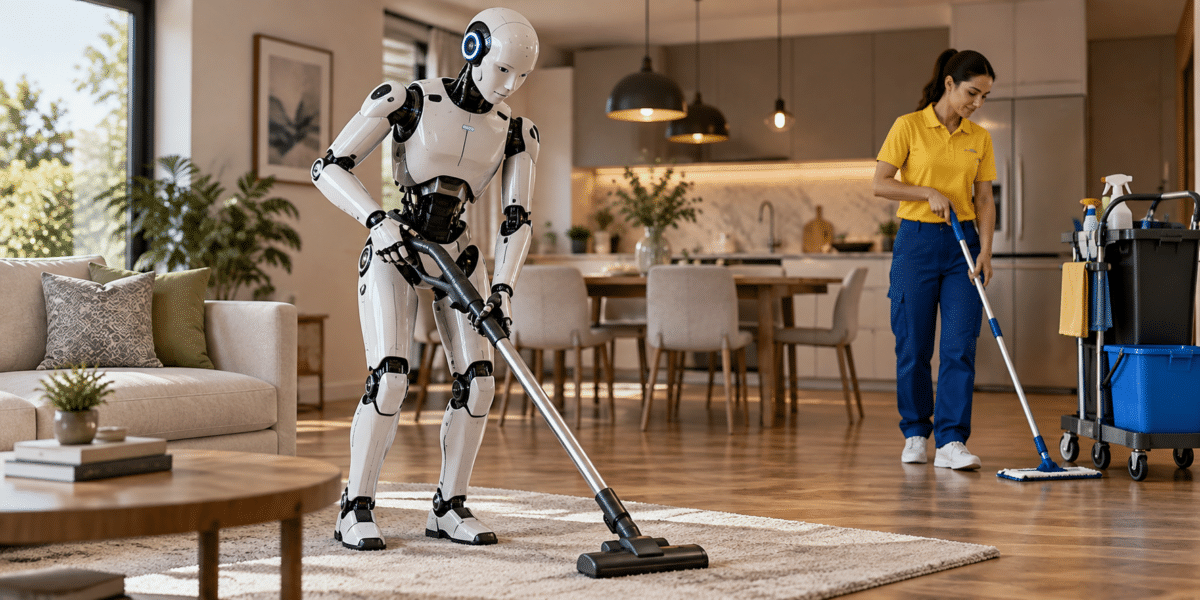
For decades, the idea of a robot cleaning your house belonged mostly to science fiction. A machine would quietly move through the home, pick up clutter, wash the dishes, scrub the bathroom, vacuum the floors, and perhaps even fold the laundry while you relaxed.
That future suddenly doesn’t feel quite so far away.
Robot vacuums are already common. More advanced machines can vacuum and mop at the same time, empty their own dust bins, wash their own mop pads, and map individual rooms. Meanwhile, a new generation of humanoid robots is being developed specifically to move through homes and perform tasks traditionally done by people.
Companies such as Tesla, Figure, and 1X are all working on robots capable of manipulating everyday objects and performing household chores.
So are we finally approaching the point where you can buy a robot and stop cleaning your house altogether?
Not quite.
The technology is advancing quickly, but there is still an enormous difference between tidying a house and actually cleaning one.
Here’s where household robots are surprisingly capable—and where human cleaners still have a major advantage.
We Already Have Cleaning Robots in Millions of Homes
The first generation of household cleaning robots didn’t look anything like people.
They were small discs traveling around the floor.
Robot vacuums demonstrated something important: homeowners don’t necessarily need a machine capable of cleaning an entire house for automation to be useful. Even automating one repetitive task can save a considerable amount of time.
Today’s better robot vacuums can:
Map multiple rooms
Avoid furniture and obstacles
Detect changes in flooring
Vacuum on a schedule
Return automatically to their charging station
Empty their own dust bins
Mop hard floors
Avoid certain rooms or areas
Increase suction over carpet
Detect particularly dirty areas
For households with pets, children, or lots of foot traffic, running a robot vacuum every day can make a noticeable difference.
But there’s an important distinction.
A robot vacuum maintains a floor.
It doesn’t clean a house.
We covered that distinction in more detail in our article about whether robot vacuums are really enough to keep your home clean.
Robot vacuums are excellent assistants. They simply aren’t housekeepers.
Humanoid Robots Change the Equation
The next phase of home robotics is considerably more interesting.
Instead of designing a specialized machine for one task, robotics companies are trying to build general-purpose robots that can interact with homes designed for humans.
That means hands capable of grabbing objects, arms capable of reaching shelves, legs capable of moving through rooms, cameras capable of identifying objects, and artificial intelligence capable of figuring out what needs to happen next.
That’s much more difficult than vacuuming a floor.
A home is one of the most unpredictable environments a robot can encounter.
A factory robot may perform the same movement thousands of times in an environment where everything has been placed precisely where it belongs.
A house is the opposite.
Shoes suddenly appear in the hallway.
A child’s toy is underneath the couch.
Someone leaves a glass on the counter.
A dining chair gets moved.
Laundry is piled on a bed.
The dog walks through the room.
Every house has different furniture, flooring, appliances, layouts, and household routines.
Humanoid robots therefore need to understand situations rather than simply follow predetermined paths.
That’s exactly what companies developing the newest generation of household robots are attempting to solve.
What Can Today’s Humanoid Robots Actually Do?
Some demonstrations now look surprisingly close to science fiction.
Robots have been shown performing tasks such as:
Picking up objects from floors
Organizing household items
Loading and unloading dishwashers
Carrying laundry
Folding or handling clothing
Opening doors
Putting items onto shelves
Taking out trash
Moving household objects
Tidying bedrooms
Making beds
Cleaning up living spaces
These capabilities are impressive because many involve dozens of small decisions that humans barely notice.
Consider something as simple as putting away a towel.
A person immediately understands that the towel is soft, flexible, may be folded, belongs in a particular location, and needs to be grasped without dropping it.
For a robot, each of those steps can be surprisingly difficult.
Artificial intelligence and machine vision are making robots much better at solving these kinds of problems.
And progress is happening quickly.
When we previously examined whether Tesla Optimus could eventually replace traditional cleaning companies, the technology was still largely focused on what humanoid robots might eventually accomplish.
The conversation is beginning to change.
The question is becoming less about whether robots will perform household tasks and more about which tasks they’ll perform well enough to be genuinely useful.
Tidying and Cleaning Are Not the Same Thing
This is where demonstrations of household robots can be misleading.
Watching a robot pick clothing off the floor looks impressive.
But professional house cleaning involves much more than moving objects around.
Consider cleaning a bathroom.
A cleaner may need to:
Identify soap scum on shower glass.
Choose a product appropriate for that surface.
Apply enough pressure to remove buildup.
Notice mildew around a corner of the shower.
Clean around faucets and fixtures.
Recognize mineral buildup caused by hard water.
Scrub grout without damaging it.
Clean the toilet.
Wipe mirrors without leaving streaks.
Vacuum hair from corners.
Mop the floor.
Move items and replace them afterward.
And every bathroom is different.
Now multiply that complexity across a kitchen, bedrooms, stairs, furniture, baseboards, ceiling fans, mirrors, appliances, and different types of flooring.
Suddenly, “clean the house” becomes an extraordinarily complicated instruction.
Need a Cleaner Before the Robots Are Ready?
The robots are getting smarter. Your bathroom probably isn’t going to wait.
Marching Maids can help with regular house cleaning, deep cleaning, move-in and move-out cleaning, and other residential cleaning services.
Fast online pricing • No obligation
Robots Are Much Better at Predictable Tasks
Automation works best when a job is repetitive.
That’s why vacuuming has been one of the easiest household chores to automate.
The robot doesn’t need to determine whether something is clean enough. It simply travels across a predefined area and vacuums it.
Other chores that may eventually become highly automated include:
Routine floor cleaning
Picking up known objects
Moving laundry
Loading dishwashers
Taking trash to a designated location
Putting commonly used objects away
Light surface wiping
Carrying household items between rooms
These are tasks where the goal is relatively easy to define.
Cleaning becomes harder when judgment is involved.
The Hardest Cleaning Problem May Be Knowing What’s Dirty
Humans are remarkably good at spotting irregularities.
Walk into a kitchen and you might immediately notice:
Grease near the stove
Fingerprints on stainless steel
Crumbs underneath an appliance
Coffee splatter against the backsplash
Dust along the top of a cabinet
A sticky spot on the floor
Nobody has to tell you where those things are.
You simply see them.
More importantly, you understand that each problem may require a different cleaning method.
That’s an enormous challenge for robots.
A machine needs to recognize the mess, identify the surface, determine the correct cleaning method, select an appropriate tool or product, perform the task, and then determine whether the result is acceptable.
That final step—knowing whether something is actually clean—is particularly difficult.
Cleaning Products Create Another Challenge
Cleaning isn’t simply mechanical.
Chemistry matters.
A product that’s perfectly safe on one surface may damage another.
Professionals routinely make decisions about:
Natural stone
Stainless steel
Glass
Finished hardwood
Laminate
Tile
Grout
Painted surfaces
Chrome fixtures
Acrylic
Fabric
Different countertop materials
Even relatively simple cleaning tools have limitations.
Steam, for example, can be extremely useful in certain situations but isn’t appropriate for every material. That’s why we previously broke down whether steam cleaners are actually worth using for everyday household cleaning.
A truly autonomous house-cleaning robot won’t just need good hands.
It will need remarkably good judgment.
Homes Are Much Harder Than Factories
Factories are designed around predictability.
Homes are designed around people.
That distinction matters.
Imagine asking a household robot to clean underneath a couch.
It might first have to determine whether the couch can safely be moved.
Then it must recognize electrical cords nearby.
There might be a child’s toy underneath it.
The floor could be hardwood rather than carpet.
A fragile lamp might be positioned next to the couch.
A pet could suddenly enter the room.
Humans process these situations instinctively.
Robots must calculate them.
The extraordinary variety inside homes may ultimately be one of the biggest obstacles preventing fully autonomous robot housekeepers from becoming commonplace quickly.
Could a Robot Eventually Deep Clean a Bathroom?
Almost certainly.
The more interesting question is when it will become economical and convenient.
A robot capable of deep cleaning a bathroom needs considerably more capability than one capable of putting laundry into a basket.
It needs dexterity.
It needs pressure control.
It needs different cleaning tools.
It needs access to water and cleaning products.
It needs to recognize different materials.
It needs to inspect its own work.
And it needs to accomplish all of this without damaging the homeowner’s belongings.
That’s a much higher standard than simply demonstrating that a robot can wipe a countertop.
The First Successful Home Robots May Work Alongside Humans
The future of house cleaning may not involve choosing between a robot and a person.
It may involve both.
Imagine a household where automation handles:
Every Day
Floor vacuuming
Light mopping
Picking up common objects
Moving laundry
Basic tidying
Every Week or Two
A professional cleaner handles:
Bathrooms
Kitchen buildup
Detailed dusting
Baseboards
Fixtures
Mirrors
Furniture
Hard-to-reach areas
Deep floor cleaning
Tasks requiring judgment
That combination could dramatically reduce the amount of dirt that accumulates between professional cleanings.
Many homeowners already use a simpler version of this system.
A robot vacuum can control daily dust and pet hair while a professional cleaner handles everything the machine can’t reach.
Humanoid robots could eventually expand that concept dramatically.
Would Buying a Robot Be Cheaper Than Hiring a Cleaner?
Eventually, this could become one of the most interesting economic questions surrounding home robotics.
A robot is an asset.
A cleaning service is an ongoing expense.
If a capable household robot could operate for years, homeowners might compare its cost with the cumulative cost of house cleaning, landscaping, household organization, elder assistance, and other services.
But there are additional expenses people may overlook.
A sophisticated household robot could require:
Maintenance
Replacement components
Software subscriptions
Electricity
Repairs
Connectivity
Cleaning tools
Cleaning products
Hardware upgrades
And unlike a vacuum, a humanoid robot contains many moving parts.
Early adopters may therefore purchase home robots primarily for convenience and technology rather than immediate cost savings.
As manufacturing scales, that equation could change.
Robots May Actually Make Professional Cleaning More Efficient
There’s another possibility that’s discussed much less often.
Robots may improve professional house cleaning rather than replace it.
Imagine a cleaner arriving at a home where a robot has already:
Removed clutter from floors
Picked up toys
Moved laundry into baskets
Cleared countertops
Vacuumed loose debris
Collected trash
The cleaner could immediately concentrate on detailed cleaning instead of preparation.
That could make each visit faster and more productive.
Technology has repeatedly transformed jobs this way.
The washing machine didn’t eliminate clothing care.
The dishwasher didn’t eliminate kitchens.
Robot vacuums didn’t eliminate vacuum cleaners.
Instead, machines handled repetitive portions of the work while people concentrated on tasks requiring more judgment.
Home robotics may follow exactly the same pattern.
What Should Homeowners Buy Right Now?
For most homeowners, purchasing multiple specialized machines probably isn’t necessary.
Start with automation that solves a repetitive problem in your home.
If pet hair accumulates constantly, a robot vacuum may be extremely useful.
If you have large areas of hard flooring, an automated vacuum-and-mop system may reduce daily maintenance.
If your biggest problem is bathrooms, kitchens, dusting, or detailed cleaning, today’s robots probably aren’t going to eliminate much of that work yet.
Technology should save time.
It shouldn’t simply give you another machine to clean, maintain, charge, update, and rescue when it gets stuck underneath the dining table.
The Most Important Question Isn’t Whether Robots Will Clean Homes
They will.
In many ways, they already do.
The better question is:
How much of the house will they eventually be able to clean without human help?
Five years ago, a robot independently manipulating household objects looked experimental.
Today, companies are demonstrating robots handling laundry, dishes, furniture, trash, bedrooms, and other household tasks.
The rate of improvement suggests household robots will become increasingly useful.
But professional cleaning sets a surprisingly high bar.
A good cleaner doesn’t simply perform movements.
They inspect.
They prioritize.
They adapt.
They recognize materials.
They notice things.
They make hundreds of tiny decisions throughout a cleaning without consciously thinking about most of them.
Teaching machines to do all of that reliably inside thousands of completely different homes may prove much harder than teaching them to walk.
The Future Is Probably Robot + Human
The robot-versus-human debate may ultimately be the wrong way to think about household cleaning.
A more realistic future is automation handling the repetitive work while people handle the unpredictable work.
Your robot might vacuum every night.
It might pick up the living room.
It might load the dishwasher.
It might eventually fold your laundry.
Then, when it’s time to remove shower buildup, clean detailed fixtures, wipe baseboards, tackle kitchen grease, or prepare the entire home for guests, a human cleaner may still be the better tool for the job.
And that’s not a failure of robotics.
It’s probably how household automation will become useful in the first place.
The robots don’t have to replace the cleaner.
They just have to make keeping a home clean easier.
The Robots Aren’t Quite Ready Yet. We Are.
Until a humanoid robot can scrub your shower, clean your kitchen, wipe your baseboards, and get your entire home ready for guests, Marching Maids can help keep your home clean today.
Choose from:
Regular house cleaning
Deep cleaning
Move-in cleaning
Move-out cleaning
One-time cleaning
Recurring cleaning
Get Pricing for Your Home
Fast online pricing • No obligation
Prefer to speak with someone?
Call Marching Maids at (888) 571-9181
Keep Reading
Interested in cleaning technology and how it’s changing the way we maintain our homes?
Will Tesla Optimus Replace Traditional Cleaning Companies?
Tesla’s humanoid robot could eventually perform household chores—but how close are we really?
Read about Tesla Optimus and the future of professional house cleaning →
Are Robot Vacuums Really Enough to Keep Your Home Clean?
Robot vacuums are convenient, but see where they excel—and where they still fall short.
See whether a robot vacuum can really replace traditional cleaning →
Are Steam Cleaners Worth It for Everyday Cleaning?
Steam promises chemical-free cleaning and impressive results, but it isn’t ideal for every surface.