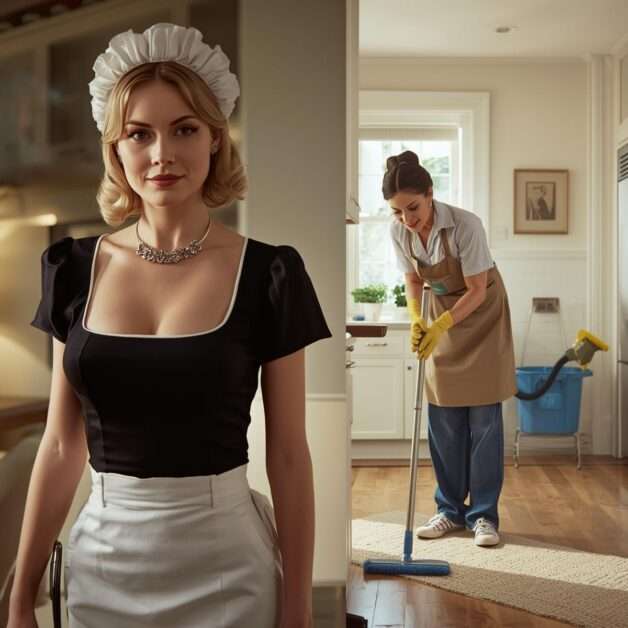
If you’ve watched The Housemaid with Sydney Sweeney and found yourself half-cringing, half-fascinated at her character’s job as a live-in maid, you’re not alone.
The film follows Millie, a young woman with a complicated past who becomes a live-in housemaid for a wealthy family in an upscale home. What starts as a chance to “start over” turns into a psychological pressure cooker: locked rooms, blurred boundaries, emotional manipulation, and a job that clearly involves far more than dusting and mopping.
For people who actually provide house cleaning services—especially independent cleaners and referral agencies in Southern California—the movie is entertaining, but it also raises a question:
How close is this to what real house cleaners do, and where does Hollywood just… go full Hollywood?
Let’s break down the differences.
1. Live-in “housemaid” vs modern professional house cleaner
In the movie, Millie moves into the family’s home, sleeps in an attic bedroom, and is essentially “on call” around the clock. Her role blurs personal assistant, nanny, housekeeper, emotional buffer, and, eventually, co-conspirator. It’s an old-school, almost gothic version of domestic work.
In real life, most modern house cleaners in Orange County—especially in SoCal—don’t live with clients at all. They’re:
Independent contractors who drive from home to home
Employees of a cleaning company
Contractors referred by a referral agency (like Marching Maids), working job to job on a schedule
They have set appointments, clear scopes of work (standard clean, deep clean, move-out, Airbnb turnover, post-construction, etc.), and defined start/end times. Their job is to clean the home, not to be absorbed into the household’s private drama.
The idea of a full-time maid living in the attic and being “available” day and night makes for a tense thriller—but it’s not how most professional house cleaning actually works today.
2. Boundaries: movie chaos vs real-world professionalism
“The Housemaid” leans heavily on blurred lines: secret conversations, emotional breakdowns in the kitchen, private arguments overheard through doors, and a boss who constantly shifts between charming, cruel, and unstable. That instability is the engine of the story.
Real cleaners, on the other hand, rely on boundaries to survive long-term in the industry.
In a typical modern cleaning relationship:
The client leaves or works from another room while cleaning happens.
The work is defined: kitchens, bathrooms, floors, dusting, maybe extras like inside the fridge or oven by request.
Payment terms and recurring schedules are agreed in advance.
Sure, sometimes cleaners hear more than they want to: family arguments, work calls on speakerphone, kids fighting over video games. But the expectation is: they’re there to clean, not to participate in the personal life of the client.
If anything, the best cleaners are the opposite of what the movie shows: very structured, very consistent, and very clear on what they will and won’t do inside someone else’s home.
3. Emotional tension vs the quiet reality of trust
One of the reasons “The Housemaid” works as a thriller is because it taps into a real, slightly uncomfortable truth: letting a stranger into your home requires trust.
The film exaggerates this into a worst-case scenario: secrets, hidden pasts, manipulation, and power games between employer and maid.
In real life, the emotional dynamic is much simpler but still powerful:
The client is trusting someone with keys, alarms, and access to their private spaces.
The cleaner is trusting that they’ll be treated fairly, paid on time, and allowed to work without harassment or unreasonable demands.
That mutual trust is why background checks, reviews, and referral systems exist. A good cleaner or referral agency protects both sides: the client’s home and the cleaner’s safety and reputation.
The average professional cleaner is not walking into a psychological thriller. They’re walking into a job site.
4. What the movie accidentally captures well
For all its drama, “The Housemaid” does highlight a few truths about domestic work.
First: cleaners notice everything.
When you’re wiping counters, moving objects, and entering every room, you naturally see small details—photos, mail piles, schedules on the fridge, the state of people’s closets and bathrooms. You see how people actually live, not how they present themselves.
Second: the job is physically demanding.
The movie shows long hallways, stairs, big kitchens, and constant motion. That part is real. Professional cleaning is hard on the body: lifting, bending, scrubbing, carrying equipment, going up and down stairs. It’s work.
Third: the power imbalance is real, even if it’s less extreme than the film
Any time someone is hiring someone else to clean their home, there’s an inherent imbalance. The key difference in real life is that ethical agencies and responsible clients work hard to keep that relationship healthy, respectful, and professional—without the control, surveillance, or manipulation that drives the plot of the film.
5. Housemaid vs house cleaner: job responsibilities compared
If you strip away the thriller elements and just compare the actual work shown on screen with what real cleaners do, the contrast becomes clear.
In the film, the “housemaid” role includes:
Being constantly available in the home
Managing not just the house, but the emotional moods of the employer
Getting pulled into personal fights and secrets
Acting as caretaker, errand-runner, and sometimes scapegoat
In the real world, a professional house cleaner’s responsibilities are far more defined:
Clean specified rooms and surfaces to a standard (floors, bathrooms, kitchen, dusting, etc.)
Use agreed-upon products or client-provided products
Respect privacy, confidentiality, and property
Start and finish within a scheduled time block
If anything, the “housemaid” label in the movie feels like a throwback to an older model of live-in domestic labor. Most modern cleaners prefer clear client relationships, predictable schedules, and enough separation that they can treat each job as one stop in a full workday—not the center of their entire life.